For patients with systolic blood pressure >140 mm Hg despite taking 2 or more antihypertensives











Not all hypertension is the same.[1d]
Could aldosterone be to blame in your patients with systolic blood pressure >140 mm Hg taking 2 or more antihypertensives? THERE IS MORE TO DO.


 Sign up
Want to be first in line for the latest information about the role of aldosterone as a driver of hypertension? Sign up here.
By clicking "Sign up," you're confirming that you agree to our Privacy Policy.
aHR=adjusted hazard ratio; aTRH=apparent treatment-resistant hypertension; ACC=American College of Cardiology; AHA=American Heart Association; BP=blood pressure; CHD=coronary heart disease; CI=confidence interval; COR=Class of Recommendation; CV=cardiovascular; CVD=cardiovascular disease; DBP=diastolic blood pressure; EMR=electronic medical record; ESKD=end-stage kidney disease; HF=heart failure; HTN=hypertension; LOE=Level of Evidence; MI=myocardial infarction; MSL=medical science liaison; NR=nonrandomized; PREVENT=Predicting Risk of Cardiovascular Disease EVENTs; R=randomized; RCT=randomized controlled trial; RR=relative risk; SBP=systolic blood pressure; TIA=transient ischemic attack; US=United States.
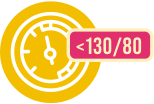
*^ An SBP goal of <130 mm Hg is a COR 1 recommendation, with LOE A, for adults with confirmed hypertension who are at increased risk for CVD. An SBP goal of <130 mm Hg is a COR 2b recommendation, with LOE B-NR, for adults with confirmed hypertension who are not at increased risk for CVD. For patients at increased risk, it is recommended to encourage an SBP goal of 120 mm Hg, while for those not at increased risk, it may be reasonable to encourage a goal of <120 mm Hg. A DBP goal of <80 mm Hg is a COR 1 recommendation, with LOE B-R, for adults with confirmed hypertension who are at increased risk for CVD. A DBP goal of <80 mm Hg is a COR 2b recommendation, with LOE B-NR, for adults with confirmed hypertension who are not at increased risk for CVD. Increased risk is defined as a 10-year predicted risk for CVD events of ≥7.5% using PREVENT. COR 1 is a strong recommendation, while 2b is a weak recommendation. LOE A is derived from high-quality evidence from >1 RCT, or meta-analysis of high-quality RCTs, or ≥1 RCT corroborated by high-quality registry studies; LOE B-R is derived from moderate quality of evidence from ≥1 RCT or meta-analysis or of moderate-quality RCTs; LOE B-NR is derived from moderate quality of evidence of 1 or more well-designed, well-executed nonrandomized studies, observational studies, registry studies or meta-analysis of such studies.
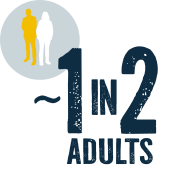
†^ Based on an analysis of data from the 2009-2014 US National Health and Nutrition Examination Survey (NHANES). Analysis was restricted to participants aged ≥20 years who self-reported taking antihypertensive medication, had ≥1 class of antihypertensive medication identified during a pill bottle review conducted as part of the NHANES examination, and had ≥3 BP measurements obtained during their study exam (N=4158). The primary purpose of the study was to compare the prevalence and characteristics of adults with aTRH using the definitions in the 2018 versus the 2008 AHA Scientific Statement. The data used above are based on the definition of uncontrolled HTN (defined as BP ≥130/80 mm Hg) from the 2018 AHA Scientific Statement.
‡^ EnligHTN is an observational, longitudinal, multinational, cohort study of over 240,000 patients with HTN that assessed clinical characteristics and real-world disease burden in patients with controlled or inadequately controlled HTN using secondary de-identified claims and EMR data of patients with HTN in the US from IQVIA ambulatory EMRs linked with IQVIA PharMetrics® Plus claims. Patient characteristics were summarized by country. Patients were included if they were ≥18 years of age, diagnosed with HTN between 2018 and 2023, treated with ≥2 antihypertensive medications for ≥30 days, and had ≥1 day of follow-up. Patients were excluded if they had secondary causes of HTN. In US patients (N=41,994), controlled HTN (n=12,864; 31%) was defined as BP <130/80 mm Hg, and inadequately controlled HTN (n=29,130; 69%) was defined as BP ≥130/80 mm Hg while concurrently treated with ≥2 antihypertensive medications for ≥30 days from index date. Hazard ratios adjusted for disease risk score were as follows: MI (aHR 1.78; 95% CI: 1.48–2.12); stroke (aHR 2.17; 95% CI: 1.79–2.64); all-cause mortality (aHR 1.25; 95% CI: 1.06–1.47); ESKD (aHR 2.54; 95% CI: 1.79–3.59).
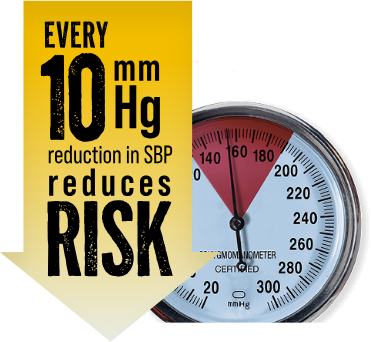
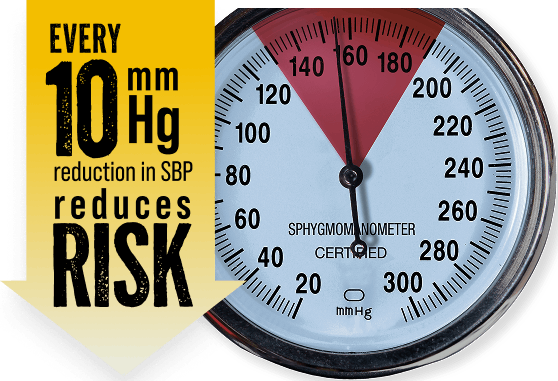
§^ Systematic review and meta-analysis of 123 randomized trials (published between 1966 and 2015) evaluated the effects of BP lowering on CV disease and mortality across various baseline BP levels and comorbidities in 613,815 participants. Data were also extracted for major CV disease events (defined as fatal and nonfatal MI, sudden cardiac death, revascularization, fatal and nonfatal stroke, and fatal and nonfatal heart failure), stroke (fatal and nonfatal, excluding TIA), and HF (new diagnosis of HF, hospital admission, or death). The relative risks for events were as follows: major CV events: 20% (RR=0.80; 95% CI: 0.77–0.83); stroke: 27% (RR=0.73; 95% CI: 0.68–0.77); HF: 28% (RR=0.72; 95% CI: 0.67–0.78).
||^ A multicenter, randomized clinical trial that compared 2 strategies for managing SBP in older adults with hypertension who were at increased risk of cardiovascular disease (n=9361). Eligible participants were adults aged ≥50 years with screening SBP between 130 and 180 mm Hg. Participants were at increased cardiovascular risk if they had clinical or subclinical cardiovascular disease, chronic kidney disease (eGFR <60 mL/min/1.73 m²), a Framingham Risk Score ≥15%, or were aged ≥75 years. Participants were randomized 1:1 to either an SBP goal of <120 mm Hg (the intensive treatment group) or an SBP goal of <140 mm Hg (the standard treatment group). The median intervention period was 3.34 years. Median follow-up was 5.11 years. Adjudicated probable dementia occurred in 149 participants in the intensive treatment group vs 176 in the standard treatment group (7.2 vs 8.6 cases per 1000 person-years; HR 0.83; 95% Cl: 0.67–1.04).
References:
- 1a 1b 1c 1d Jones DW, Ferdinand KC, Taler SJ, et al; Peer Review Committee Members. 2025 AHA/ACC/AANP/AAPA/ABC/ACCP/ACPM/AGS/AMA/ASPC/NMA/PCNA/SGIM Guideline for the prevention, detection, evaluation, and management of high blood pressure in adults: a report of the American College of Cardiology/American Heart Association Joint Committee on Clinical Practice Guidelines. J Am Coll Cardiol. 2025;86(18):1567-1678.
- ^ Carey RM, Sakhuja S, Calhoun DA, Whelton PK, Muntner P. Prevalence of apparent treatment-resistant hypertension in the United States [including online supplement]. Hypertension. 2019;73(2):424-431.
- ^ McCormack T, Suárez Fernández C, Bhalla V, et al. Risk of cardiorenal and metabolic outcomes in inadequately controlled hypertension: insights from the EnligHTN study. Poster presented at: European Society of Cardiology (ESC) Congress; August 29 – September 1, 2025; Madrid, Spain.
- 4a 4b Ettehad D, Emdin CA, Kiran A, et al. Blood pressure lowering for prevention of cardiovascular disease and death: a systematic review and meta-analysis Lancet. 2016;387(10022):957-967.
- ^ SPRINT MIND Investigators for the SPRINT Research Group. Effect of intensive vs standard blood pressure control on probable dementia: a randomized clinical trial. JAMA. 2019;321(6):553-561.